
Introduction
Imagine realizing that you are out of milk, snacks, or toothpaste and getting them delivered to your doorstep within a few minutes. This is no longer unusual in India. Quick commerce, popularly known as Q-commerce, has changed the way people think about shopping.
Platforms such as Blinkit, Zepto and Swiggy Instamart have made fast delivery a major part of urban shopping. Instead of planning a grocery trip in advance, consumers can now open an app, select what they need and receive it almost immediately.
The growth of quick commerce is not just about faster delivery. It reflects a major change in consumer expectations, buying behaviour and retail competition.
What Is Quick Commerce?
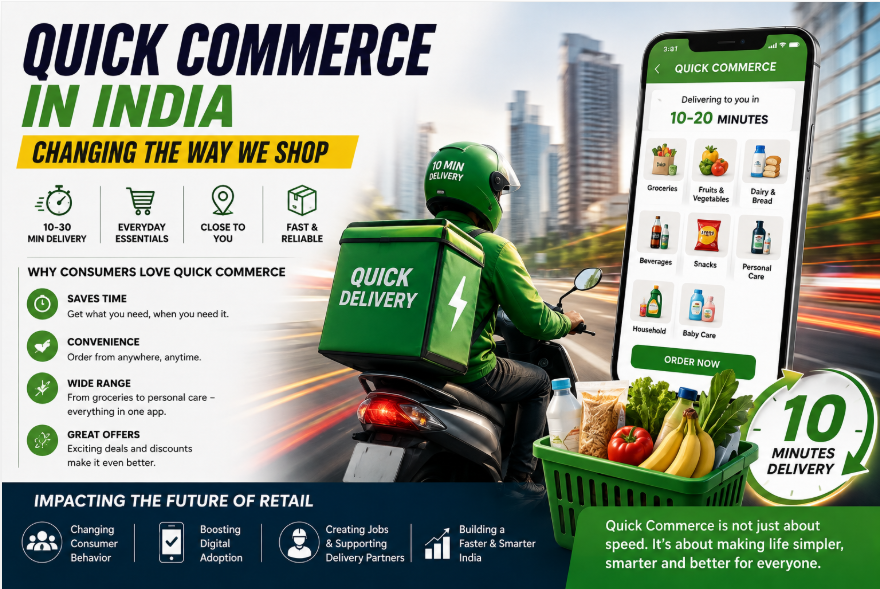
Quick commerce is a form of online retail that focuses on delivering products within a very short time, often in 10–30 minutes.
Unlike traditional e-commerce, where customers may wait one or more days for delivery, Q-commerce is designed mainly for urgent, everyday and convenience-based purchases.
Products commonly purchased through quick-commerce platforms include groceries, beverages, personal-care products, household essentials, snacks and even some electronics and lifestyle products.
Why Is Quick Commerce Growing So Fast in India?
One of the biggest reasons behind the growth of Q-commerce is convenience. Consumers today have busy lifestyles and often prefer solutions that save time.
For example, a customer may not want to travel to a supermarket just to buy a few items. With quick commerce, the same purchase can be completed from a smartphone in a few minutes.
Another important factor is the increasing use of smartphones and digital payments. Consumers are already comfortable ordering products online and making payments digitally. Q-commerce has simply made the process faster.
The rise of nuclear families, working professionals, students and urban lifestyles has also increased demand for convenient shopping options.
From Planned Shopping to Instant Shopping
Perhaps the biggest impact of quick commerce is the change in consumer buying behaviour.
Earlier, people usually made a shopping list and visited a supermarket or local store. Today, consumers can purchase products whenever a need arises.
This has increased the importance of impulse purchases. A customer opening an app to buy milk may also end up buying chocolates, chips or a soft drink because these products are displayed prominently.
Therefore, quick commerce is not only responding to consumer demand; it is also influencing what consumers buy.
The Role of Technology
Technology is at the heart of the Q-commerce business model.
Quick-commerce companies use data analytics, artificial intelligence, demand forecasting and real-time inventory management to understand what customers are likely to purchase and where demand is concentrated.
They also operate through dark stores or micro-fulfilment centres, which are small warehouses located close to customers. These locations allow orders to be picked, packed and delivered quickly.
The combination of technology, local inventory and delivery networks makes the quick-commerce model possible.
Impact on Traditional Retail
The growth of quick commerce has created both opportunities and challenges for traditional retailers.
Kirana stores have traditionally benefited from their close relationship with customers and convenient neighbourhood locations. However, Q-commerce companies are now competing on factors such as speed, product variety, discounts and digital convenience.
At the same time, traditional retailers are also adapting. Many local stores are accepting digital payments, using online ordering and partnering with delivery platforms.
Instead of completely replacing traditional retail, quick commerce may push the entire retail industry toward becoming more technology-driven and customer-focused.
The Marketing Advantage of Quick Commerce
Quick-commerce platforms have also introduced new ways of marketing products.
Push notifications, personalized recommendations, app-based discounts and limited-time offers encourage customers to make quick purchase decisions.
For brands, these platforms provide another important sales channel. A product can be placed directly in front of a consumer at the exact moment when the need arises.
This makes Q-commerce particularly attractive for FMCG brands, because products such as snacks, beverages and personal-care items can benefit from impulse buying and frequent purchases.
Challenges of the Quick-Commerce Model
Despite its rapid growth, quick commerce faces several challenges.
The first is profitability. Maintaining dark stores, delivery networks, technology and large inventories can be expensive.
The second challenge is intense competition. Companies have to continuously invest in discounts, technology and delivery infrastructure to attract and retain customers.
There are also concerns related to delivery pressure, traffic, packaging waste and the environmental impact of frequent small deliveries.
Therefore, the long-term success of Q-commerce will depend not only on speed but also on achieving a sustainable and profitable business model.
What Does the Future Look Like?
Quick commerce is likely to become an important part of India's retail ecosystem. However, the future may not be limited to delivering groceries in 10 minutes.
Companies are increasingly looking at categories beyond everyday essentials, including beauty products, electronics, fashion-related products and other lifestyle categories.
The next stage of growth could focus on better personalization, wider product selection, improved profitability and stronger integration between online and offline retail.
For consumers, this means shopping will become increasingly convenient and technology-driven.
Conclusion
Quick commerce has changed a basic question in retail. Earlier, consumers asked, “Where can I buy this?” Today, they increasingly ask, “How quickly can I get it?”
The success of Q-commerce shows that Indian consumers are willing to pay for convenience, speed and easy access. At the same time, it is forcing traditional retailers and brands to rethink how they reach and serve customers.
Quick commerce may not completely replace supermarkets or kirana stores, but it is definitely changing the way Indians shop. The real competitive advantage in the future may not simply be the lowest price—it may be the ability to deliver the right product, at the right time, with the least effort for the customer.